The results are in from the first round of the Colombian presidential elections and there will be a run-off in three weeks’ time between a far-right candidate, Abelardo de la Espriella, self-styled as the ‘Tiger’, of the ‘Homeland Defenders’ party; and the left-wing option, Iván Cepeda, of the ‘Historic Pact’ bloc. After four years of the Pact’s governing Colombia under president Gustavo Petro, the second round places the country at a political and ideological crossroads. This top-level result was not unexpected, although there are at least two surprises once one drills down into the figures.
The first is that Cepeda did not achieve the highest number of votes, as one survey after another had predicted. Instead, de la Espriella (a political newcomer who moulds himself in the image of Donald Trump and, perhaps more exactly, president Nayib Bukele of El Salvador), won by some 3 percentage points: 43.7% over Cepeda’s 40.9% – although as I write this, just hours after the polls closed, his party appears to be unwilling to accept the count, claiming in the order of 800,000 missing votes. The electoral authorities will have to make a determination on this point in the coming days.
The second surprise is that the vote of Paloma Valencia, the anointed uribista candidate – in reference to the almost omnipresent Álvaro Uribe, who still casts a shadow over Colombian politics 16 years after his two terms as president came to an end – collapsed to under 7%. Valencia and Uribe have already urged their supporters to vote for de la Espriella in the run-off, and the extra percentage points could push the ‘Tiger’ over the 50% mark – although the candidate with the greater number of votes will be declared the winner. This shift is also in line with trends across the Americas and elsewhere (not least in the UK) where the far-right has the wind in its sails, and the more-established right wing is struggling. Nevertheless, with turnout at 57% today, Cepeda’s team will throw all they can at the run-off, the more so should he be vindicated on the issue of the alleged missing votes. All the same, it is de la Espriella who will sleep more soundly tonight.
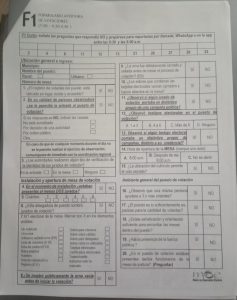
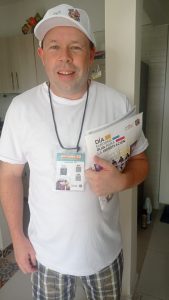
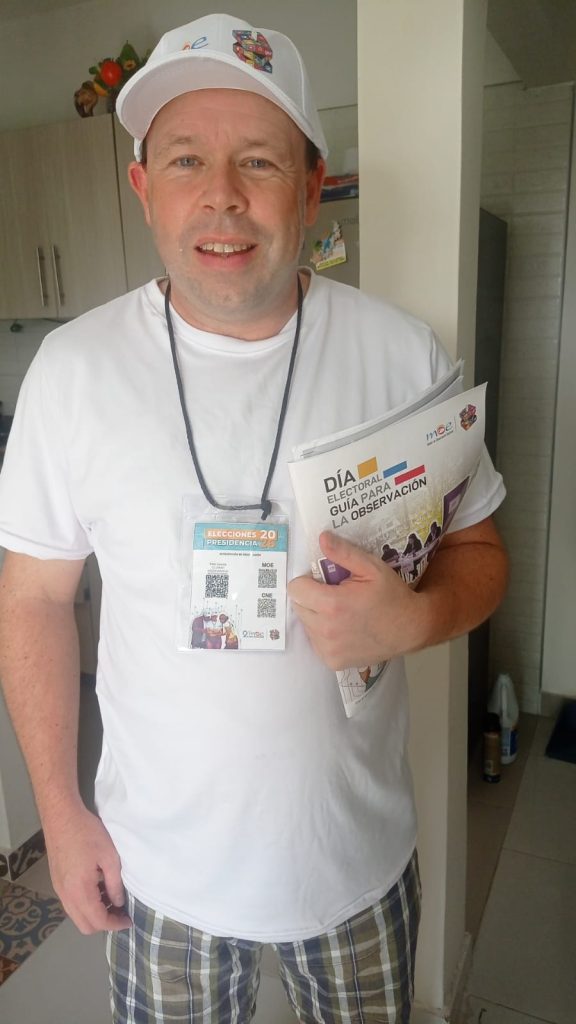
I will also sleep soundly, but for somewhat different reasons. Based between Spain and Colombia, I have spent parts of the day at a local polling station in Sincelejo, a provincial city in the Colombian Caribbean region, serving in the capacity of an election observer with the Misión de Observación Electoral (MOE) The MOE is a platform of civil-society organisations that came into being 20 years ago, when the depth of paramilitary penetration in the electoral system came to light. Since then, the MOE has stood election observers, both Colombians and internationals, for local, regional, congressional and presidential polls, and for a one-off referendum on the peace process ten years ago. I have previously undertaken this activity at the Consulate General of Colombia in London, and in Bogotá, the capital city. This process does not supplant any other electoral official’s function, but through a series of technical questions to which the observer is asked to provide a response the MOE endeavours to gauge the degree of adherence to electoral law, as well as instilling confidence more generally in the electoral process. FoR England and Scotland backed my application this year, and I have been in one of 21 regional observation stations (outside of Bogotá), with 22 different nationalities represented.
The day here ran smoothly; I was in place at 7.30am as the polling station, a local school, readied itself for an 8am start. There was a midday lull, as is usually the case but, to my surprise, this did not pick up again (as I have witnessed in the past) towards the closure of the polls at 4pm. My guess is that the heat of the afternoon puts people off coming out at that hour in this region, hence the longest queues in the morning. For the opening and closing periods, and the count itself, I was instructed to scrutinise a single table of my choice, selected at random. (The polling station contained 33 such tables, each with about 350 voters assigned to it.) I am pleased to report that the conduct of the volunteers running the table was exemplary. However, across the eight hours, only 170 people presented themselves, which put the participation at that table at under 50%, and hence beneath the national average. (I was able to roughly gauge that that some other tables had a participation rate of up to 90%.) At the count – every table across the country tots up the votes in its ballot box, and the results are quickly fed up the food chain, explaining how a national-level result can often become clear within a couple of hours – it was apparent that the two candidates who have progressed to the run-off had taken the lion’s share of the vote.
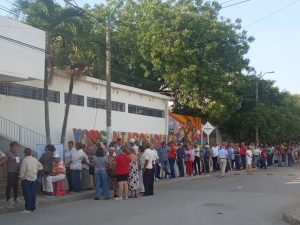
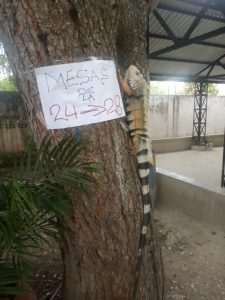
For the second round I will be back in Europe, and I shall be heading to the consulate general in Barcelona for observation. I close with a couple of other photos from the day: the queue on the street at 7.30am as I arrived (the temperature wa already topping 30 degrees) and, although taking photos at the polling station during the hours of voting is not allowed, I couldn’t resist a snap of a stripy fella trying to find his way to tables 24-28 This is the tropics, after all!